
Add-on
GeoX - Every Accident Documented, Costed, and Ready for the Insurance Adjuster
Capture every detail on the spot, nothing gets lost and your claims package writes itself
What's new in GeoX
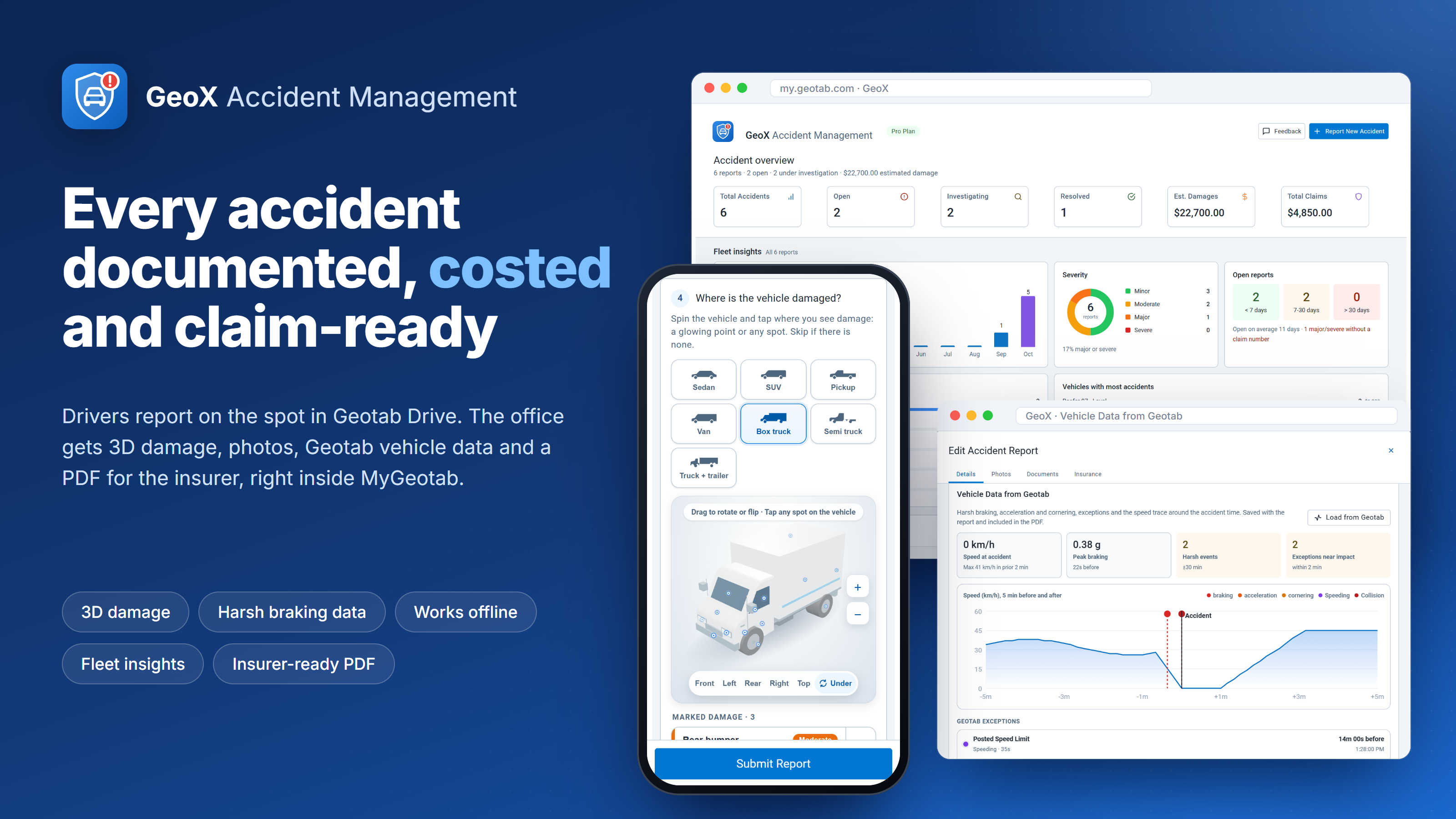
Drivers report accidents on the spot in Geotab Drive, and the office gets a complete, claims-ready file in MyGeotab: 3D damage, photos, the vehicle's own Geotab data and an insurer-ready PDF.
Mark damage on a 3D vehicle
- Seven vehicle types - Sedan, SUV, Pickup, Van, Box truck, Semi truck and Truck + trailer, each with its own 3D body and damage points (fifth wheel, fuel tanks, drive axles, trailer sides, doors and more).
- Tap any spot - tap a glowing point or anywhere on the vehicle; the spot is named automatically (for example "Left side, rear, upper").
- Spin, flip and zoom - rotate in any direction, flip to the underside, and zoom in with pinch, the mouse wheel or the +/- buttons.
- Notes and photos per spot - damage type, severity, a short note and photos for each marked spot, shown as colour-coded pins.
- The office can mark damage too - the same 3D vehicle is editable in MyGeotab, for new and existing reports.
The vehicle's own data, from Geotab
- Harsh braking, acceleration, cornering, speeding and collision exceptions around the accident time.
- Speed trace for the 5 minutes before and after, with the events marked, plus peak braking force in g.
- Loaded automatically when the vehicle or time changes, with the driver picked from Geotab or typed in.
Built for the scene
- Works with no signal - a report made offline is kept on the phone and sent automatically when the connection returns; photos that fail to upload are retried.
- Never lose a report - the report saves itself as the driver fills it in, and a progress card shows what's still needed.
- Clear, large controls designed for use at the roadside.
For the office
- Fleet insights - accidents per month, severity mix, open-report age, top accident types and the vehicles with the most accidents.
- Claims-ready PDF - 3D damage, Geotab vehicle data with the speed chart, photos, witnesses and other parties, with page numbers and the report reference.
GeoX Accident Management
Reducing Insurance Risk Through Consistent Incident Documentation
Industry: Last-mile delivery, regional fleet
A delivery client was experiencing rising insurance premiums without a clear understanding of why. Investigation revealed two contributing factors: minor incidents, bumper contact, parking-lot scrapes, low-speed collisions, were going unreported because no formal capture process existed, and when major claims did arise, the insurer received incomplete documentation. With no historical record to differentiate pre-existing damage from new incidents, the carrier priced for worst-case interpretation. Internal estimates of unreported damage costs varied widely, with no underlying data to settle the question.
The Solution
We deployed GeoX Accident Management as an add-in across the fleet. Policy was updated to require driver documentation for any incident, regardless of severity. The in-cab workflow guides the driver through a structured checklist, photos, location, time, driver statement, estimated cost, third-party details where applicable, and stores the record in MyGeotab.
Within the first quarter, the client had a complete incident dataset for the first time. Reported incident volume initially rose as drivers logged previously undocumented events; it then declined as awareness of the recording process influenced behaviour.
When a significant collision did occur, the claims pack was assembled the same day: timestamped photos, GPS coordinates, weather context, driver statement, and structured incident metadata. The carrier closed the claim materially faster than the client's historical average. At the following renewal, the premium decreased for the first time in three years.
Where This Applies
GeoX Accident Management is most relevant for fleets that:
Carry significant deductibles or are partially self-insured
Operate in high-touch environments (delivery, courier, school transport, service)
Have experienced premium increases without clear cause
Need to differentiate historical from new vehicle damage for asset management or resale
The core value is converting incident documentation from an inconsistent, after-the-fact process into a structured workflow that runs at the scene, producing claims-ready records and behavioural data over time.